 Buy now, pay later — powered by PayPal
Shielding
Copper tape for EMI & RF shielding: guitars, enclosures & noise
Copper tape shields against electromagnetic and radio-frequency interference by lining a cavity or enclosure with a continuous, grounded copper skin — a simple Faraday cage. It's the go-to fix for a guitar that hums and a low-cost way to screen sensitive electronics. This guide from Little Copper Garden explains how it works and how to do it properly.
How does copper tape shield against interference?
A continuous copper lining reflects and conducts away the stray electromagnetic and radio-frequency energy that shows up as hum and noise. When that copper skin is connected to ground, the interference it picks up drains harmlessly to earth instead of reaching your pickups or circuit. The two requirements are continuity (no gaps) and a ground connection — get both right and the shield works.
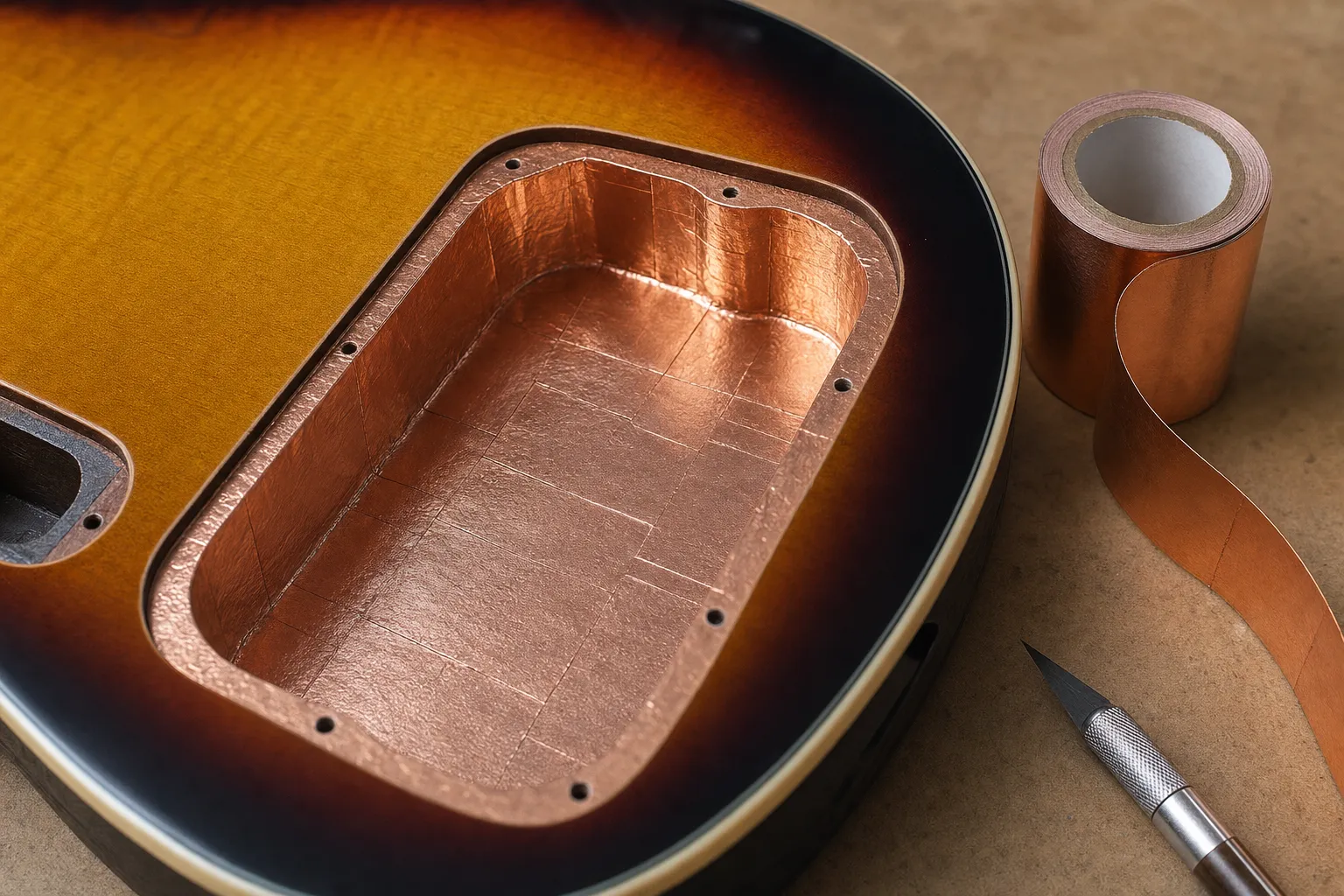
In short: a continuous, grounded copper lining acts as a Faraday cage that drains EMI/RF interference away.
How do you shield a guitar cavity or enclosure?
Work through five steps: clean the surface, line every wall and floor with overlapping strips, carry the foil up onto the lip, bond the seams and pickguard, then ground the shield to the circuit. The conductive adhesive on our tape keeps overlaps connected without soldering every join.
- Clean and dry the cavity or enclosure. Wipe the routed guitar cavity, pickguard back or enclosure walls so the surface is dry and dust-free. Clean surfaces let the conductive adhesive bond and conduct properly.
- Line every surface with overlapping strips. Cover the floor and all walls with copper tape, overlapping each strip by a few millimetres. Continuous coverage with no bare gaps is what makes an effective shield (a 'Faraday cage').
- Carry the shield up onto the lip. Run the foil up over the cavity lip so it makes contact with the back of a shielded pickguard or cover plate. The whole shielded surface needs to connect into one continuous skin.
- Bond the seams and the pickguard. Because our copper tape has conductive adhesive, overlapping seams stay electrically continuous. For a guitar, ensure the cavity shield and pickguard shielding touch so they share the same potential.
- Ground the shield to the circuit. Connect the copper lining to the instrument's or circuit's ground (commonly the back of a pot or the sleeve of the output jack). An ungrounded shield does little — it must be tied to ground to drain interference.
In short: line everything with overlapping copper, connect it into one skin, and tie it to ground.
Which width works best for shielding?
Wider tape covers walls and floors faster with fewer seams, so 20–50 mm rolls are popular for cavities and enclosures, while narrow tape handles tight corners and channels. Whatever you choose, overlap the strips so there are no bare gaps in the shield.
- Copper Tape - 5mm x 25m — £4.09
- Copper Tape - 10mm x 25m — £5.19
- Copper Tape - 20mm x 25m — £6.09
- Copper Tape - 24mm x 12m — £6.09
- Copper Tape - 50mm x 15m — £10.49
In short: wide tape for big surfaces, narrow for corners — see the width guide.
Frequently asked questions
- Does copper tape work for EMI and RF shielding?
- Yes. Copper is a good conductor, so a continuous copper lining reflects and drains electromagnetic and radio-frequency interference, acting as a Faraday cage. It is widely used to shield guitar cavities, instrument and project enclosures and sensitive electronics to cut hum and noise.
- Why does the shield need conductive adhesive?
- If overlapping strips are only joined by non-conductive glue, each strip is electrically isolated and the shield has gaps. Conductive adhesive keeps every overlap electrically continuous, so the whole lining behaves as one connected shield without you having to solder every seam.
- Do I need to ground the copper shielding?
- Yes — grounding is essential. A copper shield only drains interference when it's connected to the circuit's ground, such as the back of a potentiometer or the output jack sleeve in a guitar. An ungrounded copper lining provides very little benefit.
- Which width is best for shielding a guitar cavity?
- Wider tape covers a cavity faster with fewer seams, so 20 mm, 24 mm or 50 mm are popular for guitar control cavities and enclosure walls. Narrow tape is handy for awkward corners and routing channels. Overlap whatever width you use so there are no bare gaps.